
Halloween lands on a Saturday this year, which means an early start and a busy evening on a lot of front porches. Most of what makes a porch safe for the people walking up to it is simple: good light, clear steps, cords that belong outside, and decorations that come down in November without leaving a mark on the house. Here is the short list we would run through this week.
Light the walk, not just the door
On October 31 the sun sets a little before six in Dickson County, and it is fully dark by about half past. That is right when the first trick-or-treaters come up the walk, often in masks that cut down what they can see.
Turn your porch light on early and light the whole way to the door, not just the landing:
- Check every bulb this week. A dim or burned-out porch light is the most common gap, and a warm 2700K to 3000K LED gives plenty of light without glare.
- Add a few solar or plug-in path lights along the walk if the driveway is long or the yard is dark. Out in the county, the street will not light it for you.
- Aim motion floodlights down at the steps. A bright light pointed at eye level blinds people right when they need to see their footing.
- Light the steps themselves. The edge of each tread is what people need to see.
Keep the steps clear
The steps are where people actually get hurt. Small children, long costumes and a crowd of excited kids all arrive at the same spot at the same time.
- Keep pumpkins, lanterns and props to the sides of the steps, never on the treads.
- Sweep off fallen leaves. Dry leaves hide the edge of a step, and wet ones are slick.
- Leave the handrail bare so a hand can find it. Wrapping it in lights or garland makes it hard to grip.
- Make sure the doormat lies flat and does not slide. A rug pad or a heavier mat fixes most of them.
- Skip the fog machine on the steps. It looks great on the lawn and hides the edge of every tread on the stairs.
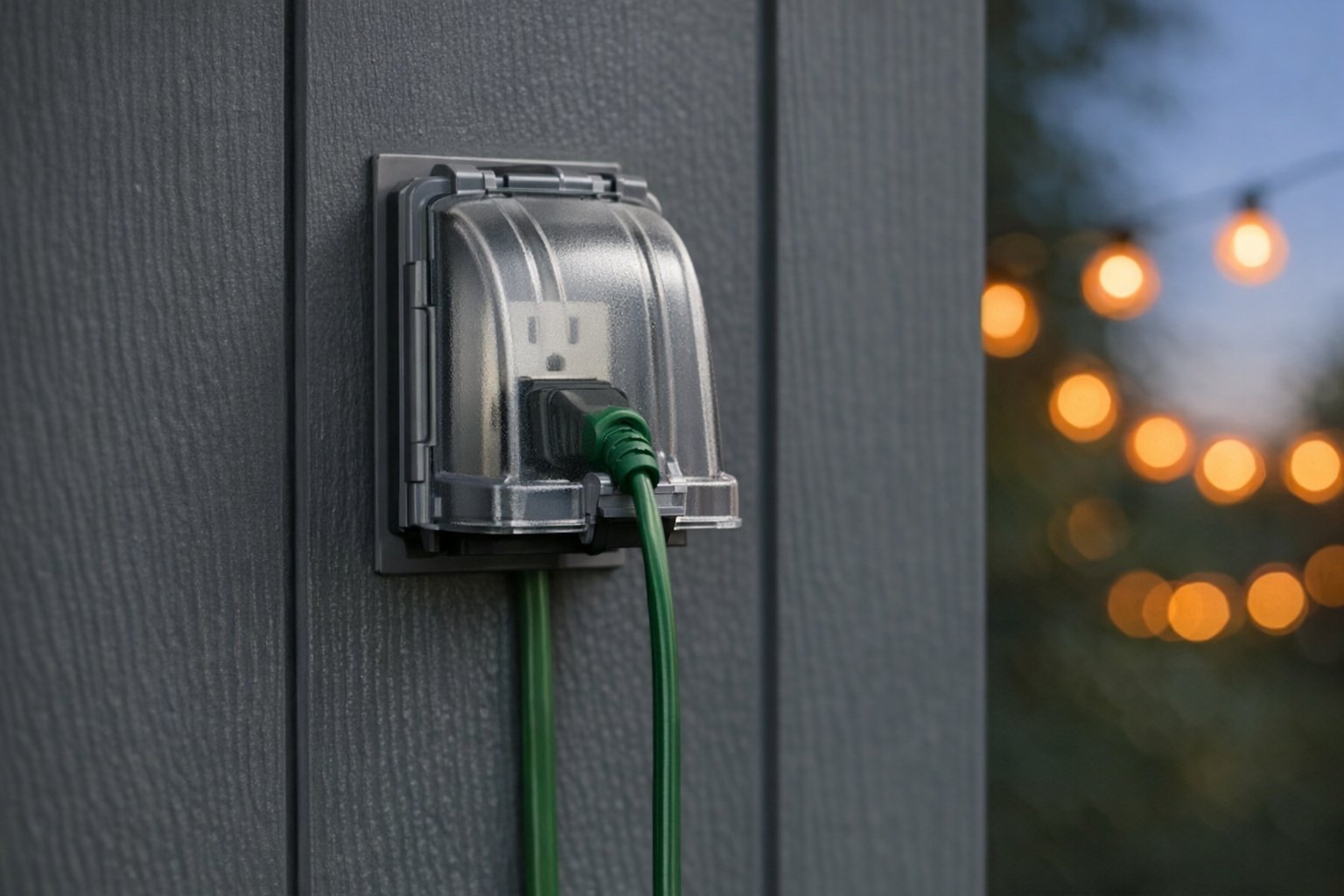
Use outdoor outlets the way they were built
Light-up pumpkins, inflatables and string lights all need power, and that power is outside in the damp. The outlets are built for it. The cords often are not.
Outdoor outlets on a newer home are required to be GFCI-protected. A GFCI cuts the power in a fraction of a second if current starts leaking somewhere it should not, like through a wet cord. Press the test button this week, then reset it, to make sure yours is working. The reset may be on the outdoor outlet itself, on an outlet in the garage, or on a breaker in the panel. It is worth knowing which before the night you need it.
- Use cords rated for outdoor use. Look for a W in the code printed on the cord's jacket, such as SJTW.
- Keep the outlet's in-use cover closed over the plug. The cover is the bubble-shaped one that shuts with a cord still in it.
- Do not run a cord under a doormat or rug, or through a door or window that closes on it. Pinched insulation is how a cord overheats.
- Do not chain one extension cord to another. Use one cord long enough to reach, or a second outlet.
- Put the lights on a timer, so nothing runs all night once the porch light goes off.
If an outdoor GFCI keeps tripping, do not keep resetting it. That usually means water has found a plug, a cord or the outlet box. Unplug everything, let it dry out, and call an electrician if it still trips.
Secure what can blow over
Late October in Middle Tennessee can bring a windy front through overnight. A loose inflatable can end up in the road or across the steps.
- Stake every inflatable and yard figure with all of its tethers, not just the ones that are easy to reach.
- Keep the inflatable's fan clear of leaves so it does not clog and overheat.
- Turn inflatables off overnight and in high wind. It saves the fan, and the neighbors will not miss it at 2 a.m.
- Keep stretchy fake cobwebs off porch lights and bulbs. The webbing is a light synthetic fiber, and it does not belong against anything that gets hot.

Protect the porch itself
Decorations come down in a day. The marks they leave can stay for years, and a new porch is the easiest place to avoid them.
- Set pumpkins on a tray, a plant saucer or a piece of cardboard. A pumpkin that starts to soften leaks, and the juice can stain stained wood and concrete.
- Use battery candles in jack-o'-lanterns. They look nearly the same, and a real flame next to a costume or a pile of dry leaves is not worth the risk.
- Hang things from removable adhesive hooks, not nails or screws in the siding, trim or porch columns. A nail hole in siding is a small leak waiting for the next rain.
- Test tape on a hidden spot of painted trim first, and pull it off slowly at a sharp angle when it comes down.
A few things for your guests
A good porch is also about the people who come up it.
- Keep dogs inside or behind a closed door. Doorbells, masks and a steady stream of strangers are hard on even a calm dog.
- Keep the walk to your door short and obvious. If you are not handing out candy, turn off the porch light. In most neighborhoods, a dark porch means skip this house.
- If you are going out, leave a bowl only if the porch is well lit and the steps are clear. A dark porch with candy on it still draws people up the steps.
The morning after
Clocks fall back the next morning, Sunday, November 1. That makes it a good day to do the twice-a-year checks: smoke and carbon monoxide alarms, the HVAC filter and the dryer vent. We will cover those next week.
If you are looking for a porch of your own in Dickson County, see the homes we have ready now, or call us at (615) 574-3954.